鋼琴的音準 (Pitch) 是取決於 鋼琴弦線的 震動長度 (Speaking Length) 及 拉力 而產生的 震動頻率. (也可參考 Taylor’s Formula)
震動長度 (Speaking Length) 是已被 鋼板, 音板 及 Bridge 設計 所限, 並 無法改變.
所以在日常會改變鋼琴音準的因素只有 弦線的拉力. 弦線 愈能夠 維持拉力, 鋼琴音準的穩定性就愈高.
以下 三點 是 影響 弦線 拉力 的主要日常因素:
-
物料縮漲 – 環境因素 (主要 溫度 及 濕度 的改變) 會令 物料收縮 或 膨漲. 這不單指是弦線本身, 也 包括 音板 crown 的變化而透過 Bridge 對弦線產生的壓力變化.
-
Pin Block 狀況 – Pin Block 在老化 及 磨損的情況之下, 其 抓緊 調音釘 (Tuning Pin) 的能力也有所降低, 也就是 鋼琴在結構上維持弦線拉力的能力下降.
-
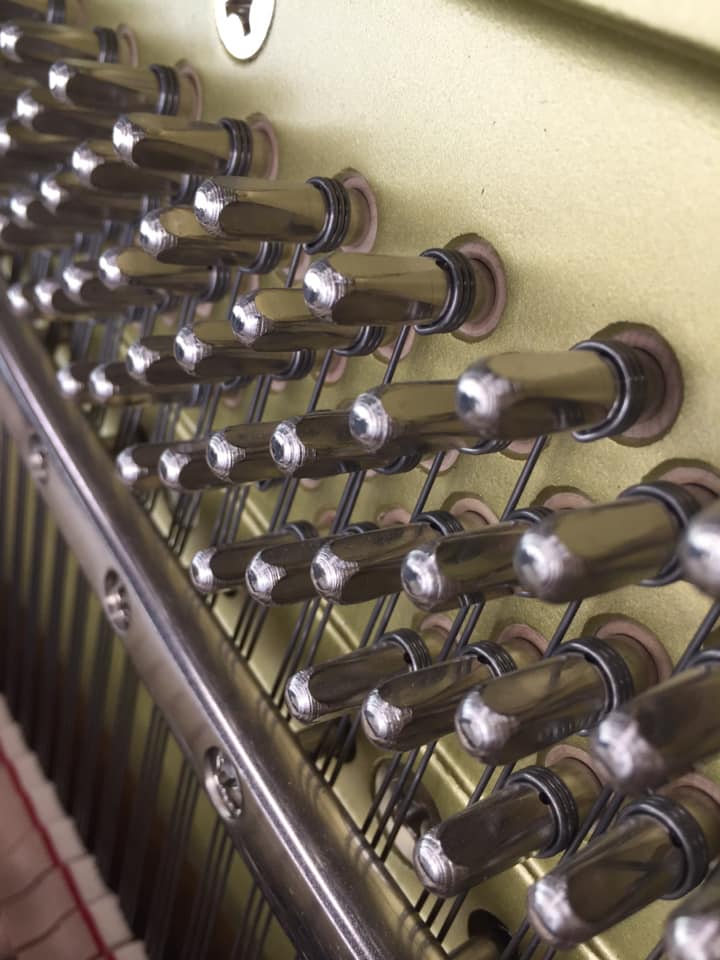
弦線的習慣性 – 在 安裝弦線的方式 則是 在 調音釘 (Tuning Pin) 繞圈 並 鎖緊. 這意味 弦線有多習慣其 拉力 及 型狀 會對 鋼琴音準的穩定性 有直接影響.
提高鋼琴音準穩定性的方法
-
小心控制鋼琴所在的環境 – 不只是控制 溫度 及 濕度, 也需要 考慮合適放置鋼琴的位置.
-
定期調音 – 弦線反覆地調至同一的拉力, 久而久之會習慣其 拉力 及 型狀. 如果你的鋼琴已有一定的穩定程度, 你可以參考 鋼琴生產商的保養建議. 你也可以向你所信任的鋼琴技師查詢 最適合你鋼琴的調音建議.
Wire’s inherent physical properties
this is a well-known issue in piano maintenance: new or recently tuned piano strings (especially plain steel music wire) often lose tension and drop in pitch shortly after tuning due to the wire’s inherent physical properties. This is commonly described as “string stretch” or “settling,” but the root cause involves creep (time-dependent deformation), stress relaxation, and mechanical settling in the coiled sections around the tuning pins and at the wire’s bends. It is not the tuning pins slipping (unless the pinblock is worn) but the wire itself adjusting under extreme tension.
Key Physical Properties of Piano Wire
Piano wire (also called music wire) is high-carbon spring steel, typically ASTM A228 grade. It is cold-drawn through dies to achieve extreme tensile strength (often >2,000 MPa ultimate) and a fine pearlitic microstructure that gives it springiness and high elasticity. This process work-hardens the metal, aligning grains and creating high dislocation density, but it also leaves the wire with:
• High yield strength yet enough malleability to bend without immediate fracture.
• Residual stresses from manufacturing and installation (coiling around tuning pins, sharp bends at the nut/bridge/hitch pin).
• Viscoelastic-like behavior under sustained high stress (strings operate at tensions of hundreds of pounds per wire, near but below the elastic limit).
At room temperature and under these loads, the wire exhibits slow creep and stress relaxation—atomic bonds break and reform via thermal diffusion, dislocation climb, and grain-boundary sliding. This favors gradual lengthening (or effective tension loss) over hours to weeks.
Why It “Uncoils” or Relaxes Shortly After Tuning
1. Coil Settling on Tuning Pins
The wire is wound 2.5–3.5+ times around the tuning pin (the “becket” or coil section is non-speaking length). When you tune, the coils are not instantly perfectly tight—there is microscopic slack, especially in the upper coils. Under tension, the lowest coil tightens first, then upper coils gradually tighten and “settle” downward. This redistributes a small amount of wire length, effectively reducing speaking-length tension and dropping pitch (often 50–100+ cents initially). More coils (common in some older or restrung pianos) take longer to stabilize. Tuners sometimes grip the coil with pliers and give it a counter-clockwise twist to accelerate this, after which pitch noticeably drops.
2. Bends and Bearing Points
The wire makes sharp 90°+ bends at the agraffe/nut, bridge pins, and hitch pin. These create localized plastic deformation (outer radius stretches slightly, inner compresses). Over time, the wire “settles” into these bends, relaxing residual stresses and lengthening the effective vibrating segment very slightly.
3. Creep / Stress Relaxation
Once tuned to exact pitch (fixed strain), internal stress decays over time. This is mathematically modeled as exponential relaxation: the frequency (pitch) follows something like F = F_1 + F_2 e^{-t/\tau} , where \tau is days to months. Early relaxation is fastest—hence the quick drop right after tuning. Vibration from playing accelerates it by helping dislocations move.
New strings or freshly restrung pianos show this most dramatically because the wire has not yet “learned” its bent/coiled shape under load. Older strings stabilize after repeated tunings.
Bass Wound Strings (Copper-Coiled Core)
If the question refers to the wound bass strings (steel core + copper winding), a similar “uncoiling” can occur: the helical copper wrapping loosens or separates from the core due to the same tension/relaxation effects plus age/corrosion. This causes buzzing or dull tone. Techs fix it by loosening the string, twisting the entire assembly in the direction of the copper winding (usually 1–2 full turns), then retuning. This re-tightens the winding against the core.
Practical Notes
• Stabilization techniques: Experienced tuners “chip” (raise pitch well above target then settle), over-pull slightly, massage bends, or pre-stretch new wire to force most relaxation upfront.
• Not permanent: After 2–4 tunings in the first months, the rate slows dramatically as the wire reaches equilibrium.
• Environment (humidity/temperature) and playing intensity also affect how quickly this happens, but the wire’s own metallurgy is the fundamental driver.
This behavior is why even perfectly tuned pianos need frequent initial retunings and why high-quality modern wire (with better consistency and plating) still requires it—though less extremely than 19th-century iron wire. It’s simply the physics of a highly stressed, cold-worked spring steel under real-world conditions.
等到嚴重走音才安排調音,長遠來說費用會更高
考慮到鋼琴琴弦的穩定性,由於高碳彈簧鋼琴弦 具有潛變(creep)、應力鬆弛(stress relaxation)以及調音銷上線圈逐漸鬆弛、彎曲點應力釋放等物理特性,新調好的琴弦或新換弦的鋼琴在調音後不久(數小時至數週)便會出現音高明顯下降的現象。這是琴弦在極高張力下,內部晶粒滑移與殘餘應力逐漸釋放的自然結果,無法完全避免。
因此,定期根據鋼琴實際狀況進行調音,遠比等待嚴重走音後才一次性大修更具成本效益,主要原因如下:
1. 加速琴弦穩定過程,減少反覆勞動:
頻繁的小幅度微調,能讓琴弦的線圈與彎曲點更快「定型」,使應力鬆弛現象逐漸趨於平穩。一旦琴弦達到平衡狀態,後續走音速度便會大幅減慢。反之,若長時間不調,琴弦大幅偏離音高後,調音師需花費更多時間拉高張力、逐一處理鬆弛線圈,甚至需多次「過拉」(over-pull)才能穩定,此時單次調音工時大幅增加,費用自然更高。
2. 防止累積性損壞,避免高額後續維修:
長期嚴重失調會使琴弦承受不均勻張力,導致線圈鬆脫、橋釘磨損、音板裂縫或調音銷鬆動等問題。這些損壞一旦發生,就可能需要更換整組琴弦、修復銷板或甚至翻新音板,費用往往是定期調音的數倍甚至十倍以上。定期調音則能及早分散這些應力,延長琴弦與整體結構的使用壽命。
3. 縮短每次調音時間,降低單次與長期總成本:
當鋼琴僅輕微走音(例如每日使用環境濕度變化所致)時,調音過程通常只需30–60分鐘,費用較低。若等到偏差過大,調音時間可能延長至2小時以上,且需額外處理技術性問題(如線圈重整)。長期來看,多次短暫調音的總花費,遠低於少次長時間大修的累積成本。
4. 維持樂器價值與演奏性能:
定期保養能讓鋼琴音色穩定、觸感一致,保持其音樂價值與二手市場價格。若因忽略調音導致音質劣化或結構損傷,後續翻新或重修的支出將遠高於預防性保養。對專業演奏者或家庭而言,這也避免了因琴音不準而影響練習或表演的隱形成本。
5. 因應個別狀況,彈性調整最經濟:
每台鋼琴的使用環境(香港潮濕氣候)、使用頻率、琴齡與換弦時間不同。新琴或新換弦的鋼琴前半年可能需3–4次調音,老琴則視實際走音程度每半年至一年1–2次即可。根據狀況量身調整(而非盲目固定時間表),能精準分配資源,避免不必要的浪費,達到最佳成本效益。
總結而言,定期根據鋼琴狀況調音,並非「花錢買穩定」,而是利用琴弦物理特性的預防策略。它能讓高成本的「一次性大修」轉化為低成本的「持續微調」,大幅降低長期維護總支出,同時延長鋼琴壽命與價值。這正是專業鋼琴技師一致推薦的做法,尤其在香港這樣氣候變化較大的地區,更顯重要。
湯 先生/ Mr. Tong
英國註冊鋼琴技師 / Registered Piano Technician (MPTA)
Leave a Reply