The grand piano action is the ingenious mechanical system that translates the pianist’s finger movement on the keys into the hammer striking the strings. It’s one of the most sophisticated mechanisms in musical instrument design, perfected in the 19th century and still used today.
Introduction
-
The action is the heart of the piano’s responsiveness.
-
It allows for control of dynamics (soft vs. loud), repetition speed, and nuance of touch.
-
The grand piano action is more advanced than the upright piano action because it uses gravity (not springs) to reset the hammers, enabling faster repetition.
Main Components
-
Key → the part you press with your finger.
-
Whippen (lever assembly) → transfers motion from the key to the hammer.
-
Jack → a small lever that pushes the hammer toward the string.
-
Repetition lever → unique to grand pianos, allows the hammer to reset quickly without the key returning fully.
-
Hammer → covered with felt, strikes the string to produce sound.
-
Damper → felt pad that stops the string’s vibration when the key is released.
How It Works (Step by Step)
-
Key pressed → the back of the key lifts the whippen.
-
Jack engages hammer → pushes it toward the string.
-
Escapement → just before striking, the jack slips out so the hammer can fly freely (prevents blocking).
-
Hammer strikes string → sound is produced.
-
Repetition lever → holds hammer close to the string, allowing rapid repetition.
-
Key released → damper falls back onto the string, stopping the sound.
Why It Matters
-
Enables fast repetition (up to 14 strikes per second).
-
Provides wide dynamic range from pianissimo to fortissimo.
-
Gives pianists the ability to shape tone with subtle finger control.
Fun Fact
The double escapement mechanism, invented by Sébastien Érard in 1821, is what makes the modern grand piano action so responsive. Without it, Liszt’s virtuosic passages or Ravel’s shimmering textures would be nearly impossible to play.
Reference:
Wikipedia – https://en.wikipedia.org/wiki/Action_%28piano%29
Askenfelt & Jansson – The Acoustics of the Piano – https://www.speech.kth.se/music/5_lectures/askenflt/timing.html
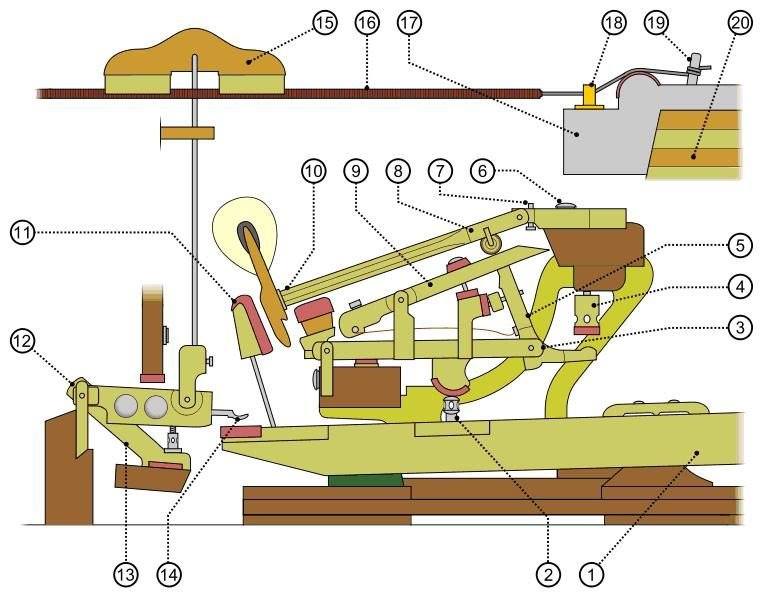
(1) Key
(2) Capstan
(3) Wippen
(4) Regulating screw
(5) Jack
(6) Hammer flange screw
(7) Drop screw
(8) Hammer shank
(9) Repetition lever
(10) Hammer
(11) Back check
(12) Damper lever
(13) Damper tray
(14) Spoon
(15) Damper
(16) String
(17) Plate
(18) Agraffe
(19) Tuning pin
(20) Pin block
Additional Information:
Upright Piano Action
湯 先生/ Mr. Tong
英國註冊鋼琴技師 / Registered Piano Technician (MPTA)
Leave a Reply